

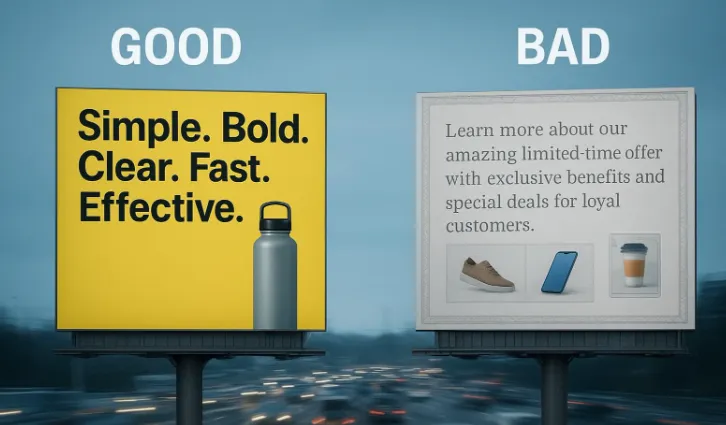
Ordering a billboard that actually works means setting clear goals, picking locations based on real data, and keeping the design simple. Start by choosing one main goal-like getting more website visits or improving brand recall-and then match it with a highly visible spot that your target customers pass often. If you follow a clear process that includes a good creative brief and careful performance tracking, a basic roadside sign can become a strong, profitable part of your marketing.
Out-of-home (OOH) advertising has moved far beyond basic posters. Today, it is a smart mix of physical presence and data-driven planning. Whether you want to build a local footprint or work with experts such as BE Media – order a billboard in Poland, you should treat the billboard as a key part of your whole marketing plan, not an isolated purchase. When done well, billboards give your brand a sense of stability and credibility that online-only campaigns often struggle to create.
What makes a successful billboard campaign?
A strong billboard campaign is based on simplicity and repetition. Drivers usually have only three to seven seconds to see and understand your message, so the best billboards follow a “seven-word rule,” making sure the main idea is clear at a glance. High-contrast colors, bold fonts, and one strong image help your ad stand out from all the other visuals on a busy road.
Placement is just as important as design. The winning boards are the ones that your ideal customers see over and over on their normal routes. It’s not only about the total number of cars that pass, but how often the right people pass. Frequency builds slowly over time, and campaigns that run for several months are more likely to make your brand the one people think of when they are finally ready to buy.
What are the benefits of billboard advertising?
Billboards are one of the last true mass-reach channels, connecting with people during everyday life without needing clicks, cookies, or algorithms. Unlike many digital ads that can be skipped, muted, or blocked, a billboard is always visible, day and night. This constant exposure helps build trust and makes your brand feel established in the local area. Research shows that about 90% of people notice OOH ads, making billboards a strong tool for wide awareness.
Billboards also work as a powerful “starter” for digital marketing. Studies show that 39% of people who see a billboard later visit a store or search for that brand online. Once someone has seen your brand in a real-world setting, your search and social ads feel more familiar and reliable. This connection between offline and online channels is a big reason OOH is growing again, often giving an average return on investment close to 497%.
1. Define Campaign Goals and Budget for Your Billboard
How to clarify your primary billboard objective
Before you look at maps or design ideas, decide what the billboard should achieve over the next 3 to 12 months. Most campaigns focus on one of three main goals:
- Brand awareness – building name and logo recognition.
- Direct response – calls, website visits, or sign-ups.
- Foot traffic – getting people to visit a store or event.
For example, a law firm might want long-term name recognition, while a restaurant near a highway exit might care most about driving immediate visits. Trying to chase several goals on the same board usually weakens the message and makes it harder for drivers to understand what to do.
To keep your goal sharp, use the SMART method: Specific, Measurable, Achievable, Relevant, and Time-bound. Instead of “get more business,” aim for “increase branded searches by 20% in Q2.” A clear goal like this will guide later choices about location, design, and your call-to-action.
What should you consider when setting your billboard advertising budget?
Your budget should match both your market size and how visible you want to be. Billboard prices depend on traffic volume, how popular the location is, and the format (static or digital). A rural billboard might cost around $500 per month, while a premium spot in a major city can be more than $25,000 per month. You also need to plan for one-time costs like vinyl printing and installation for static boards, often around $1,500 per face.
When planning your spend, think about a steady run instead of a brief burst. In many cases, it is smarter to choose a slightly cheaper location and keep it for six months than to spend your whole budget on a prime site for just two weeks. Repetition is what builds memory, so your budget should support ongoing exposure. To ensure your investment is optimized, working with an experienced advertising agency like BE Media can help you conduct a media audit and select the most effective locations, from public transport to iconic city landmarks.
How to determine the best campaign duration
Many billboard contracts start with a four-week minimum, but campaigns of three to six months usually perform better. Running an ad for a full year is even stronger, because people will see it during different situations-commuting, shopping on weekends, and during seasonal travel. Over time, this helps smooth out short-term spikes and dips and gives you better data on which messages work at different points in the year.
If you can’t commit to 12 months right away, plan your contract so you can extend good locations. Ask your media partner how renewals work and if longer bookings qualify for lower monthly rates. Building a “landmark” billboard presence on a key road can make your brand feel like a permanent part of the area, but that effect takes time.
2. Select the Right Billboard Type and Location
What are the differences between static and digital billboards?
Static billboards are the classic format. They use a printed vinyl sheet on a fixed structure and give you 100% of the display time. Because your ad is always up, they are great for building recognition and a stable presence. The downside is that they are harder to change. Updating the message means printing a new vinyl and paying again for installation.
Digital billboards (Digital Out-of-Home, or DOOH) use LED screens to show multiple ads in rotation, usually in 6-10 second slots. You share the screen with other advertisers, but you gain high flexibility. You can change your creative remotely, add time-based messages, and test different versions without printing costs.
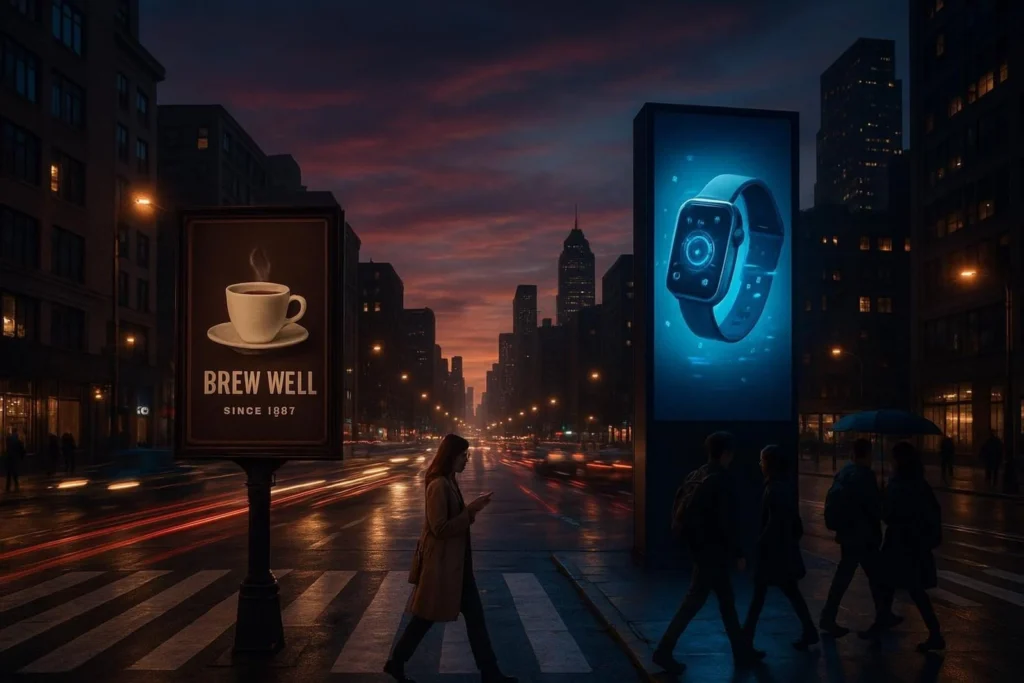
Should you choose digital billboards for your campaign?
Digital boards are a strong choice if your message needs to change often. Good uses include:
- Time-based offers, like a “Happy Hour” special that only runs from 4-6 PM.
- Weather-based messages, like a tire shop showing rain tire ads when it starts raining.
- Frequent updates, such as events, countdowns, or flash sales.
Digital billboards also have shorter lead times; once your file is ready, your ad can often go live within hours.
If your main goal is long-term brand presence in one neighborhood, a static board may still be better. Because your message is always visible, anyone who passes by sees it every time, without waiting through a loop of other ads.
How to identify high-impact billboard locations
High-impact sites are about more than just how many cars pass by. You also need to think about:
- Dwell time – How long people can see the board (stopped at lights vs. speeding past).
- Visibility – Whether the board is clearly in view or blocked by buildings, trees, or signs.
A board at a busy intersection with long red lights can be more valuable than one on a fast highway because drivers have more time to read it.
Check the “approach view” for each site. A board visible from 400-500 feet away gives drivers enough time to see and understand the message. Use tools like Google Street View to check for any new obstacles that might block the view.
How to match locations to your target audience’s drive paths
Good placement starts with understanding where your customers live, work, and spend time. For example:
- A local HVAC company might focus on commuter routes leading into suburbs with many homeowners.
- A B2B software brand might choose boards near office parks, tech zones, or business districts.
Match the geography of your billboards to your real service area. Paying for a busy board on the north side of the city is wasteful if most of your buyers are on the south side. Use your actual customer data to spot the main roads and “arteries” that feed your best areas.
What to look at when reviewing traffic data and visibility
Billboard traffic data is usually shown as “Average Daily Impressions” or “Vehicles Per Day.” These numbers are useful, but you also need to think about who the audience is. Are they tourists passing through once, or local residents who will see your board many times each month? Local commuters provide more frequent exposure, which is better for brand building.
Visibility also includes the placement angle. A “right-hand read” (on the right side of the road) usually works better than a left-hand read because it sits directly in the driver’s main line of sight. Check the speed limit, too: the faster the road, the simpler and bolder your layout needs to be.
3. Purchase Your Billboard Space: Direct vs. Agency
Should you buy direct from billboard owners or work with an agency?
Many local businesses start by buying directly from a billboard company. This keeps communication simple and gives you direct access to local site information. If you need only one or two boards in one city or town, buying direct is often the cheapest and fastest option. Building a relationship with a local operator can also help you hear about last-minute discounts or openings.
Agencies are most helpful when you want billboards in several cities or want to combine outdoor with other media like radio, online, or TV. Agencies can compare inventory from many owners at once and help you spread your budget across multiple sites. They also handle tasks like negotiating contracts and coordinating creative files with different vendors.
What to look for in billboard advertising proposals
A solid billboard proposal should clearly list:
- Each location address and ID.
- The format (static or digital).
- The contract length.
- The monthly rate.
- All one-time fees (printing, installation, or file processing).
For digital boards, the proposal should also state your “share of voice” (how long your ad runs and how often in the loop).
Don’t judge offers on price alone. Review current photos-both day and night-and a map of each site. If a vendor won’t provide photos or updated traffic data, treat that as a warning sign. Keep all proposals in writing so you can compare them side by side.
How to compare pricing, CPM, and overall value
The standard way to compare billboard costs is CPM (Cost Per Mille, or cost per thousand impressions). Use this formula:
| Example | Value |
| Monthly rate | $2,000 |
| Monthly impressions | 100,000 |
| CPM | $2,000 ÷ 100 = $20 |
CPM helps you see how many impressions you get for each dollar spent. However, a low CPM is not always a good deal. A cheap board in an area your target audience rarely visits is still wasted money. Balance CPM against audience fit and location quality. A board in the center of your best trade area can justify a higher CPM because those impressions are more valuable.
Key contractual elements to confirm
Before you sign, read the contract carefully. Pay attention to:
- Posting and takedown dates – Do they match your planned launch?
- Maintenance clause – Does the owner commit to fixing torn vinyl or LED issues within 24-48 hours?
- Cancellation terms – How much notice do you need to end the campaign (often 30-60 days)?
- Ownership of vinyl – Do you get to keep it, and will they store it for reuse?
These details help protect your investment from delays, damage, and unexpected costs.
4. Design Compelling Billboard Creative
What to include in your creative brief
A clear creative brief leads to stronger designs. It should cover:
- The single main goal of the ad.
- The specific target audience.
- The one key message you want people to remember.
- Your brand colors and logo files (high resolution).
- Any legal text you must display.
- Any special offer or product name you want to highlight.
Share photos of the real location with your designer. Knowing whether the board is surrounded by sky, trees, or buildings helps pick colors that stand out. For example, if there is a lot of green in the background, avoid green layouts and choose bright, contrasting colors instead.
Billboard design principles for maximum readability
Keep your message short. If you can’t say it in seven words or fewer, it’s probably too long for drivers. Use large, simple, sans-serif fonts and avoid thin or fancy scripts that are hard to read from a distance.
High contrast is key. Examples include:
- Black text on yellow.
- White text on dark blue.
- Dark text on a light, solid background.
Use one strong, clear image instead of many small ones. A single photo that shows your product or someone using your service communicates faster than a block of text. Place your logo where it is easy to see, but don’t let it crowd the layout.
Tips for matching the billboard message with your digital campaigns
Your billboard should feel like it belongs with your website, social media, and other ads. Use the same key headline, value promise, and general look. This repeated message across channels helps people recognize and remember your brand.
If you are promoting a specific offer, keep it consistent. For example, if your billboard says “Save 20%,” the landing page that people visit should use the same phrase and discount. This avoids confusion and makes the buying process smoother.
Technical specifications for billboard artwork
For static billboards, you usually need:
- High-resolution files (often 300 DPI at print scale or a reduced scale).
- CMYK color mode for accurate printing.
- Bleed and trim areas so no important text or logos are cut off.
For digital billboards, you typically need:
- RGB color mode.
- Exact pixel sizes (for example, 1920×1080) or specific ratios given by the vendor.
- Moderate brightness-avoid pure white backgrounds (use slightly off-white, such as RGB 235,235,235) to prevent glare at night.
5. Prepare for Launch and Installation
What happens after you sign your contract?
Once you sign and pay the deposit, production starts. For static boards, the owner sends your approved artwork to a large-format printer. The vinyl is printed, cured, and then sent to the local team for installation. This usually takes around two weeks after final art approval.
For digital boards, the process is faster. The operator checks your file for correct size and quality, then uploads it into their scheduling system. Your ad can often go live on a specific day and time with just a few system updates.
How to review proofs and confirm installation
Always ask for a proof that shows your artwork at scale before printing or upload. This is your last chance to catch mistakes like wrong phone numbers or website URLs.
After the board goes live, the vendor should send Proof of Performance (POP) photos-clear daytime and nighttime shots of your ad on the actual structure. Compare these images with what you expected. Check:
- Color accuracy.
- That the vinyl is smooth, without wrinkles or tears.
- That there are no unexpected obstructions blocking the view.
If something is wrong, contact your representative quickly to discuss fixes, credits, or a different location if needed.
Best practices for promoting your new billboard on digital channels
Don’t rely only on drive-by views. Once your billboard is up, take clear photos or short videos and share them across your digital channels. Mention the location and explain why you chose it. This extra exposure extends your reach without extra media cost and links your offline and online presence.
You can also run a simple “spot our billboard” contest, such as: “Take a safe photo of our board on Highway 50 and tag us for a chance to win a gift card.” This encourages user-generated content and proves that people are noticing your campaign.
6. Measure Billboard Effectiveness and Improve Results
Which performance metrics should you track?
Even though billboards don’t get clicks, you can still measure their impact. Focus on “lift” in key areas during the campaign period compared to the period before launch. Useful metrics include:
- Direct website traffic.
- Branded search volume (people searching your brand name).
- Phone call volume.
- Form submissions or inquiries.
If you use a special tracking phone number or a custom URL, you can link those leads directly to the billboard. Have staff note when customers say things like “I saw your sign,” and log these comments in your CRM for a fuller view of performance.
How to connect billboard campaigns to online activity and leads
To track response more precisely, use tools such as:
- Vanity URLs – Simple custom links like YourBrand.com/Save that lead to a dedicated landing page.
- Promo codes – Codes like “BOARD10” used at checkout, tied only to the billboard campaign.
More advanced setups may also use geofencing. This technology can flag mobile devices that pass your billboard and later visit your website or store. Many modern OOH providers now include this type of reporting in premium packages, giving you more proof of real-world results.
When to rotate creative or change locations for better performance
Treat your first billboard effort as a test. After about three months, review the data. If you see higher awareness (more searches, more direct visits) but weak response (few calls or sign-ups), you might need a clearer call-to-action or a stronger offer.
Digital boards make it easy to update creative quickly, so try new headlines, visuals, or offers and compare results. If you have multiple locations and one clearly outperforms the others, consider moving some of your budget to that corridor. OOH campaigns work best when you keep adjusting your message and placements rather than setting them once and leaving them unchanged.
Common Mistakes to Avoid When Ordering a Billboard
The most common error in billboard advertising is overcrowding the design. Many businesses try to include their address, phone number, website, long slogans, and lists of services all on one board. At highway speeds, people can only absorb one or two key elements. If your board looks like a flyer, most drivers will ignore it. Aim for:
- One bold image.
- One short, clear headline.
- One simple way to respond (URL or phone number).
Another frequent problem is weak color contrast. Light text on a light background-such as pale blue on white-may disappear in sunlight or low light. Choose combinations with strong contrast to keep your message visible.
Many advertisers also skip visiting or closely reviewing the location. A board might look great on a spreadsheet, but if it is partly hidden behind a bridge or visible for only a couple of seconds, its true value is lower than the numbers suggest. Always review photos or see the site in person when possible.
Key Takeaways for a Billboard Campaign That Delivers
OOH is changing quickly thanks to programmatic buying. Similar to online ads, programmatic OOH lets you bid on billboard space in real time based on audience data. This makes it easier for smaller brands to access outdoor media and to focus budget on the people most likely to respond.
Environmental responsibility is becoming more important too. More companies are using solar-powered digital boards and recyclable printing materials to reduce waste. As cities adopt smarter infrastructure, billboards are starting to serve dual roles-sharing public updates such as traffic information alongside commercial messages.
By staying aware of these trends and following clear steps-setting focused goals, choosing the right locations, keeping designs simple, and tracking results-your billboard campaign can do more than just get attention. It can support steady, long-term growth for your brand.

