

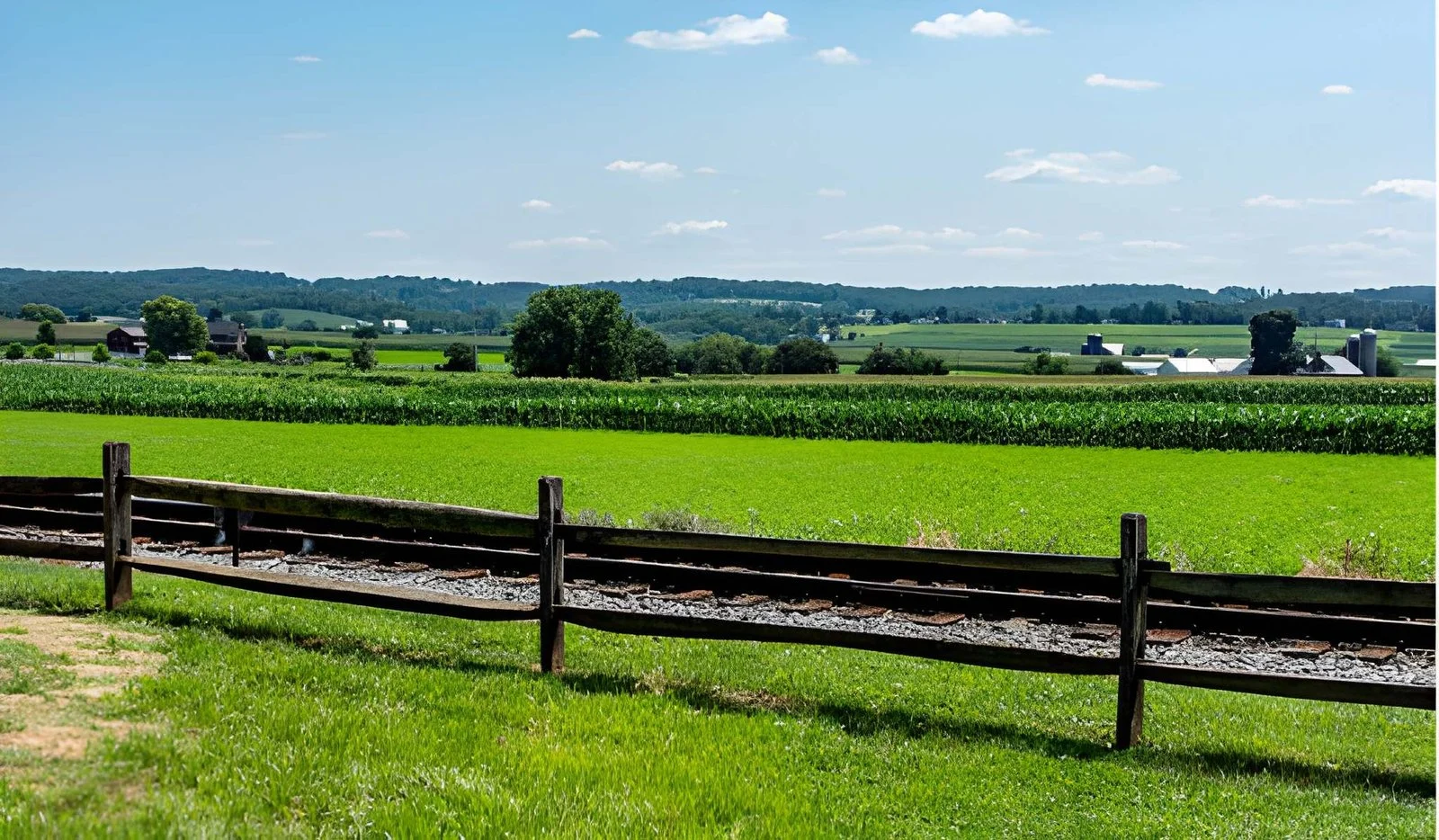
Marking 2.5 acres does not have to cost what the first quote said. The arithmetic behind that number is simple and a little unfair: a solid privacy fence prices out per foot at roughly three times what split rail does, so the figure that made you close the laptop was mostly boards nobody actually asked for. Split rail marks the line. It does not hide anything behind it.
For a first-time owner of a couple of acres, that trade is usually the whole answer, and the crews doing fence installation easton ct hear the same story every spring. The property line is invisible, the oil truck keeps clipping the corner of the lot, and the privacy quote came back at three times what the budget held. So here is the plain version of the argument, before any numbers: fence the road frontage in split rail, leave the back and side lines alone for now, and a $6,000 ceiling holds.
Where The Money Goes Post By Post
Split rail is sold by the section, not by the foot, and that alone changes how a quote reads. A section is the span between two post centers, usually 10 or 11 feet, so 480 feet of road frontage works out to about 45 sections and 46 posts. Rails are the cheap part. Posts are what you pay for, because every one of them gets dug, set plumb and backfilled by a person standing in your yard.
Say installed two-rail runs $12 a linear foot and three-rail runs $16, illustrative numbers rather than a quote from anybody. Your 480 feet lands at $5,760 the first way and $7,680 the second, so the third rail is the whole difference between inside the ceiling and over it. Add a 12-foot drive gate with hardware at $600 to $800 and the two-rail version still sits under the $6,000 line (gates are the line item nobody thinks to ask about). The tape measure does not negotiate, which is why the frontage figure matters more than the per-foot figure.
Before anyone comes out to measure, pull the lot up on CT ECO, the state’s free public map viewer, and measure the road side yourself. The case we see most often is a homeowner pricing the full perimeter at 1,300 feet when only 480 of it faces anything. That single correction saves more money than any material substitution will.
Questions Buyers Ask Before The First Quote
Three questions come up before a contract gets signed, in roughly that order. None of them are about wood species. They are about whether the fence does the job this particular property needs done.
Will Split Rail Keep A Dog In?
Not on its own. Two-rail and three-rail both leave gaps a beagle walks through without breaking stride. Owners who need containment add welded wire or black mesh to the inside face, which costs a few dollars a foot on top of the fence and keeps the open look from the road.
How Deep Do The Posts Have To Go?
Below frost. In this part of Connecticut that generally means a hole somewhere in the range of 30 to 36 inches for a line post, with corner and end posts going deeper because they carry the tension. If a written quote never says how deep the posts are set, ask that question before you ask about the price.
Do I Need A Permit For A Fence On My Own Land?
Rules vary by town, so check with Easton’s land use office rather than taking a contractor’s word for it. Many Connecticut towns exempt residential fences under a certain height from a building permit while still applying setback and sight-line limits near the road. Wetlands and old stone walls can trigger their own review, which is worth raising early instead of after the holes are dug.
Material Prices Moved More Than Labor Did
Crew rates in Fairfield County have held steady enough that two quotes a year apart usually differ because of lumber, not labor. NAHB’s framing lumber price tracker put softwood framing lumber at $558.19 per 1,000 board feet in early August 2026, a year-over-year decline of 2.6%, with prices still swinging on tariffs, supply-chain disruption and thin domestic production. That is the market sitting underneath a split rail quote, because rails and posts come out of the same softwood supply. A 2.6% dip does not rewrite a $6,000 budget on its own, but the volatility is why a verbal number from last fall will not hold today.
In practice this typically means asking for a quote that separates material from labor, then asking how long the price is good for. Thirty days is common. Ninety is generous. A number with no expiration on it is worth confirming in writing before you plan the rest of the yard around it.
Fence The Frontage First And Stop There
Frontage-first is not a compromise, it is a sequence. The road side is where the boundary confusion and the corner-cutting delivery trucks actually happen, and it is the stretch anyone driving past will judge. Wrap all 2.5 acres at once and the number triples to mark lines the neighbors already respect. Do the 480 feet now, live with it a season, and decide next spring whether the side lines are worth another $4,000.
So when you call around for fence installation Easton CT crews can still schedule this year, ask for the section count and the post depth in writing, and have the frontage priced on its own line. That is a quote you can compare against another one. Two-rail across 480 feet, gate included, under $6,000 is a realistic target rather than a wish, and it puts a visible boundary on the property this season instead of next.

