

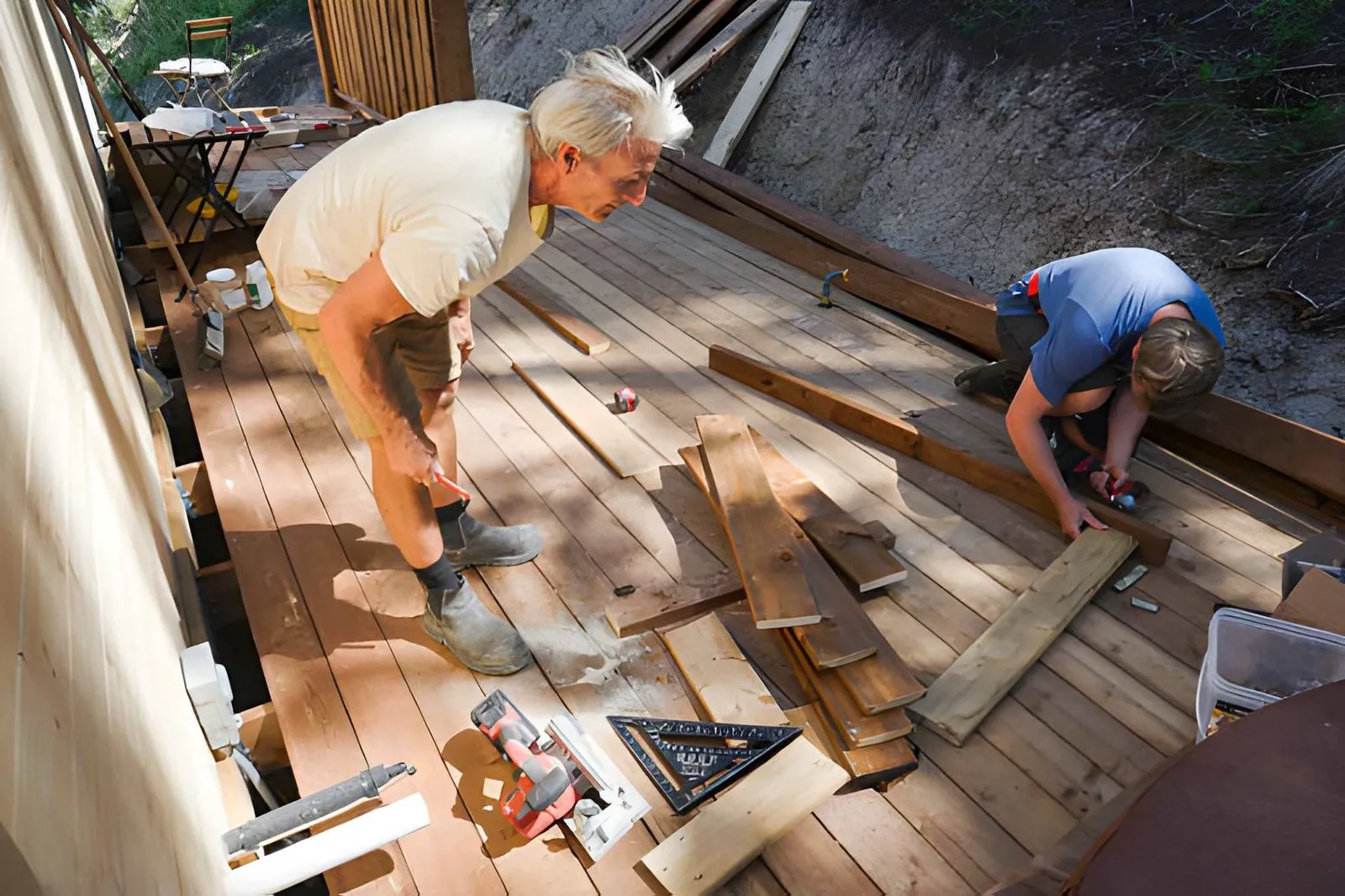
Cutting a deck design by a third almost never cuts the price by a third. A large share of what you pay for sits underground and behind the siding before a single board goes down: the drawings, the permit, the crew and equipment arriving, the footings dug below the frost line, the ledger board bolted and flashed to the house. So a $24,000 plan redrawn to fit a $9,000 savings balance gives back mostly square footage, which is the one thing homeowners miss the day the furniture goes out. That gap is the reason custom deck builders monkton md get asked about monthly payments long before anyone asks about board color. The argument of this piece is plain: financing the design you actually want usually costs less over a decade than building a small deck now and paying to extend it later.
Smaller Decks Do Not Shrink The Fixed Costs
Concrete goes in the ground either way. The footings do not care how big the deck on top of them is.
A permit review costs what it costs at 200 square feet and at 380. The same is true of the site visit, the layout, the excavation setup, the dumpster, and the two days of labor that go into the connection between deck and house. Trim the plan and those line items barely move, so the percentage you cut off the drawing is not the percentage you cut off the invoice. Here is a rule worth keeping: if the thing you are cutting is structural, footings, beams, a second set of stairs, you save real money. If it is surface, decking boards, railing runs, a screened section, you are mostly moving a bill into the future and adding a fresh setup charge to it. Footings below the frost line and correctly flashed ledger attachment are never the place to economize, whatever the budget says.
Run The Monthly Number Before Cutting The Plan
The first feature to get cut is almost always the covered or screened section, and it is the first one people ask us to come back and build. The job we get called back for most often is an extension of a deck somebody trimmed four years earlier. Part of why that screened space matters in northern Baltimore County is the hardwood canopy that makes the yard worth sitting in at all. Researchers at NC State University College of Natural Resources reported in April 2026 that hardwood pollen from species like oak runs two to three times smaller than pine pollen, roughly one-third to one-half the thickness of a human hair, small enough to be inhaled rather than simply swept off a table. Screening will not filter a particle that fine, and nobody should sell it to you that way. What it changes is where the furniture can live in April and how often you drag the hose out.
So price both versions before you redraw anything. Any of the custom deck builders monkton md homeowners shortlist should quote the full plan and the trimmed plan on one visit, and the gap between the two stops being a feeling and becomes a number you can sit with. Say the full design comes to $24,000 and you have $9,000 in the account. Put $6,000 down, hold $3,000 back for the surprises every project turns up, and finance $15,000; at a hypothetical 10 percent across seven years that payment lands near $249 a month. Now price the other road: a $16,000 deck this spring, then an $11,000 extension three years out when the cash exists, which is $27,000 of construction plus a second permit, a second mobilization and another week of your yard as a job site. Ask what that later extension would cost as a standalone job. The honest answer is usually more per square foot than the same footage costs today, because you are paying twice for everything that is not lumber.
Finance The Build You Will Not Redo
Monthly payment plans through a lender are not free money, and the interest on a seven-year term is real money you would rather keep. But interest on the correct deck still beats paying two crews to build one deck in two passes. Look at the term, the rate, whether there is a prepayment penalty, and what happens if you clear the balance in year three after a raise. Then measure that against the version of the yard you settle for, because the deck that fits your savings today is the deck you will be tearing boards off in 2030.

