

The furnace gets blamed first, and the furnace is usually innocent. In a 1954 Cape Cod north of downtown Columbus, the bills that rattled its brand new owners came out of thirteen original wood sashes, every one of them single pane, most of them older than the interstate that runs past the neighborhood. By the second bill the couple was pricing out replacement windows Upper Arlington OH crews install all winter long. The argument here is simple, and this house proved it. Energy-efficient replacement units cut a starter home’s gas bill further than thermostat discipline ever will, because the heat was never leaving through the thermostat.
A New Homeowner’s First Heating Bill Shock
November came in at $180, which felt survivable. January was $261, and the thermostat had not moved off 68 all month. They did what almost everyone does, which is change the furnace filter, then read for two nights about whether a smart thermostat would claw it back. It would not have. In practice the first winter in an old house exposes the envelope, and this one exposed it as condensation running down the inside of the glass every morning before breakfast.
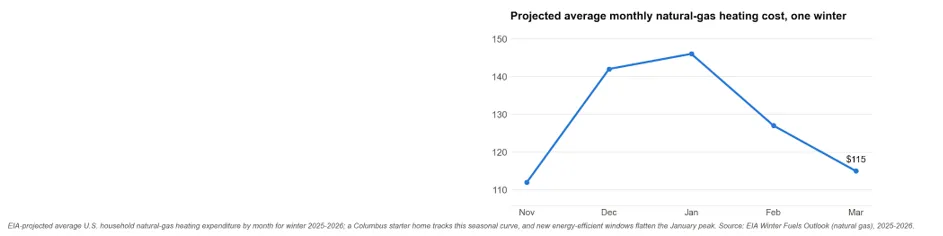
The shape of that curve is ordinary. What is not ordinary is how much of the January peak a leaky window assembly can own in a house of this vintage. The upside is well documented, and an April 2026 retrofit review in Materials (Basel) reports that insulating walls, roof, floor and windows alongside better mechanical systems can cut energy costs, demand and emissions by nearly 50%. Nobody in this story did all of that at once. They did the glass.
Where Old Single-Pane Sashes Leak Heat
A single pane is about an eighth of an inch of conductor standing between a 70 degree living room and a 12 degree January night. Heat crosses it, the chilled glass cools the air touching it, that air drops toward the floor, and the room reads as drafty even with the sash locked shut. Then add the gaps where a seventy-year-old sash no longer meets its frame squarely. Eight of the thirteen openings had no storm window, and the glazing putty on the south side crumbled under a thumbnail.
The fix is not simply newer glass. It is what installers call a low-E coating, meaning a metallic layer thinner than a fingerprint that bounces room heat back inside instead of letting it radiate out through the pane. Pair it with two panes, an argon fill, and a frame that actually seals, and the assembly stops behaving like a hole in the wall.
Settle one thing before anyone touches a sash in a house this old. Paint on sashes and sills in a 1954 home is very likely lead, and a window that slides is the exact friction surface that turns old paint into dust. Under the EPA’s lead renovation, repair and painting rule, any firm disturbing painted surfaces in a home built before 1978 has to be certified and lead-safe trained. Ask to see that certificate before the first sash comes out.
What Replacement Actually Changed That Winter
The crew pulled and replaced all thirteen openings in four days, saving the original interior trim and the stubby little casings around it. Condensation stopped that same week. The back bedroom over the unheated crawl space, always the cold room, started reading within two degrees of the hallway instead of six or seven, and the owners quit shutting its door at night. None of that shows on a bill. It is the part they talk about.
The Month-By-Month Payback We Tracked
The payback did not arrive as one dramatic month. In the first week the change was comfort rather than cost, since the meter had barely turned over. By week three the daily gas draw on the utility app was running roughly a fifth under the same stretch in January. Month two is where dollars appeared: February landed at $198 against January’s $261. Before anyone calls that a $63 win, February was the milder month, so the honest like-for-like figure is closer to $40.
March came in at $171. Within 60 days of the install the household was spending forty to sixty dollars less per month on gas than the same house had spent before, and across a full Columbus heating season that pace lands somewhere near $400. That is a projection rather than a receipt, and a brutal December would move it. Comfort is not a projection.
What A Starter-Home Owner Should Take Away
The benefit nobody shops for is quiet. Glass mass is what settles a room, and trade publication Window + Door puts the gain from doubling mass per unit area at roughly 6 decibels of sound transmission loss. The arterial two blocks east dropped out of the household soundtrack, a thing you only notice once it is gone.
If you are holding a $260 gas bill in a 1950s starter house, suspect the sashes before you suspect the furnace. Quotes for windows Upper Arlington OH homeowners actually buy are normally priced per opening, so the work can be staged: coldest rooms this year, the rest next fall, no second mortgage required. Get the per-opening number in writing before anything is ordered. For seventy-one winters that little Cape Cod had been heating the backyard. It stopped.

