

Keeping one veterinary relationship instead of three is almost always the cheaper way to run a place with pets and a few head of livestock. That is the argument, and the arithmetic behind it is dull enough to check on the back of a feed receipt. A five-acre household outside Knoxville with two dogs, one horse, and six ewes pays for that split twice, once in exam fees and again in windshield time. That is why typing veterinarians Knoxville IA into a phone at 2am and landing on a mixed practice matters more than the price of any single visit. Every clinic you add is another minimum farm call, another set of records, another after-hours number that may or may not pick up. The animals do not care how the invoices are organized. You will notice it around the fourth one.
Splitting Care Across Clinics Adds Up Fast
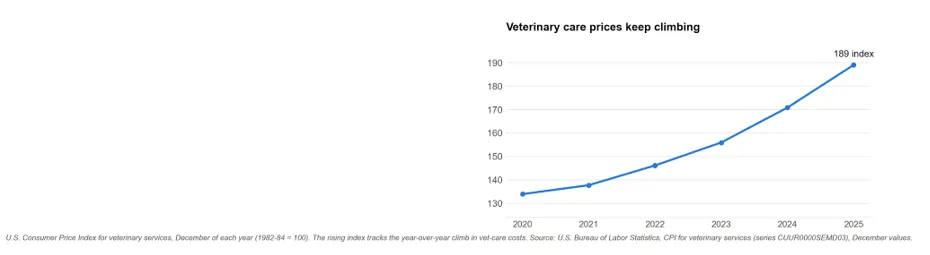
Animal care is not getting cheaper, and nobody in the business pretends otherwise. The American Pet Products Association reported total pet spending of $158 billion in 2025 and projected $165 billion for 2026, a figure the group released in March 2026. The federal price index for veterinary services tells the same story, climbing from roughly 134 in 2020 to 189 by the end of last year. Rural households feel that twice over, because livestock work carries a travel charge before anyone touches the animal.
Run one spring through the numbers and the pattern shows up quickly. Say the small-animal clinic charges $65 an exam and both dogs go twice a year, which is $260 before a single vaccine. The equine vet adds a $95 farm-call fee to a $70 float and comes out twice, so call that $330. Sheep work sits 40 miles the other direction, two trips at $85 each, another $170. Add one after-hours call at $150 when a ewe lambs on a Saturday night, and the year comes to $910. Roughly $190 of that bought no medicine at all, only a truck moving down a gravel road.
Those figures are illustrative, though the shape of them rarely changes. The rule is simple enough to hold in your head. If everything you own fits in a carrier, a small-animal clinic on its own is fine and you can stop reading here. If there is a horse or even one ewe on the place, a mixed practice that knows your barn costs less over a year than two specialists who each bill a trip. In practice that usually means fewer trip charges, fewer duplicate lab panels, and one person who remembers which dog reacts badly to which vaccine. The mileage is where a household budget springs a leak, and nobody quotes you that line up front.
One Rural Practice Covers Every Animal You Own
Plenty of families start with a search for veterinarians Knoxville IA neighbors recommend, then watch the shortlist collapse the moment large animals come up. Small-animal clinics generally do not float teeth or pull a lamb. Large-animal practices often do not board a beagle or scale a cat’s molars. A full-service rural practice sits in the middle of that gap on purpose, which is why the model persists across rural Iowa.
Continuity matters most on the schedules that cannot slip. Puppy vaccination is the cleanest example of that. Texas A&M’s veterinary school notes that a parvovirus series starts at 6 to 8 weeks of age, with boosters running until the puppy is 16 to 20 weeks old. Protection is not complete until that last dose lands. Change clinics in April, miss the middle of that window, and you have an unprotected puppy on ground where parvovirus survives for months. One practice holding every record catches that. Three practices each assume somebody else is watching the calendar, and the same goes for rabies dates and deworming intervals.
The other half of the value turns up at hours nobody wants to work. A ewe in trouble at 2am does not reschedule, and neither does colic. A practice that already has your file, your address, and your gate code can be moving within minutes. A clinic meeting you for the first time is still asking who you are and what you own (a fair question, rough to answer one-handed with a flashlight). Emergency coverage for established clients is worth asking about on a Tuesday afternoon, not discovering on a Saturday night. On-farm calls are the same kind of question. A vet who will come to the pasture saves you the trailer, the loading, and an hour of coaxing a sick animal.
A Single Vet Relationship Saves Real Money
Set the emergency drama aside and the routine bill still favors consolidation. The American Veterinary Medical Association reports average annual veterinary spending near $598 per dog-owning household, against roughly $529 for households with cats. Neither of those figures carries a farm call inside it. Two dogs, a horse, and a small flock push a rural household past those averages, so a hundred dollars of avoidable trip fees is no rounding error. Consolidating does not make any individual exam cheaper. What it removes is the second and third truck, plus the phone tag and record requests that ride along with them.
Pick the practice by what it can handle on your worst night, then let the routine work follow it there. Ask whether the same clinic can vaccinate the dogs and come out for a lambing, and what happens at 2am for an established client. If the answer covers both, the yearly total usually settles lower than a split arrangement, because the trips stop stacking. That is a boring reason to switch. Boring reasons are the ones that still hold up when the invoices land in February.

